

Amsterdam has always had a soft spot for people who dare to think differently.
For free love. For outspoken identity. For art in unexpected places. And now, apparently, for robots with an exceptionally good eye for ear styling.
During WorldPride Amsterdam 2026, Piercings Works is proud to present a world first:
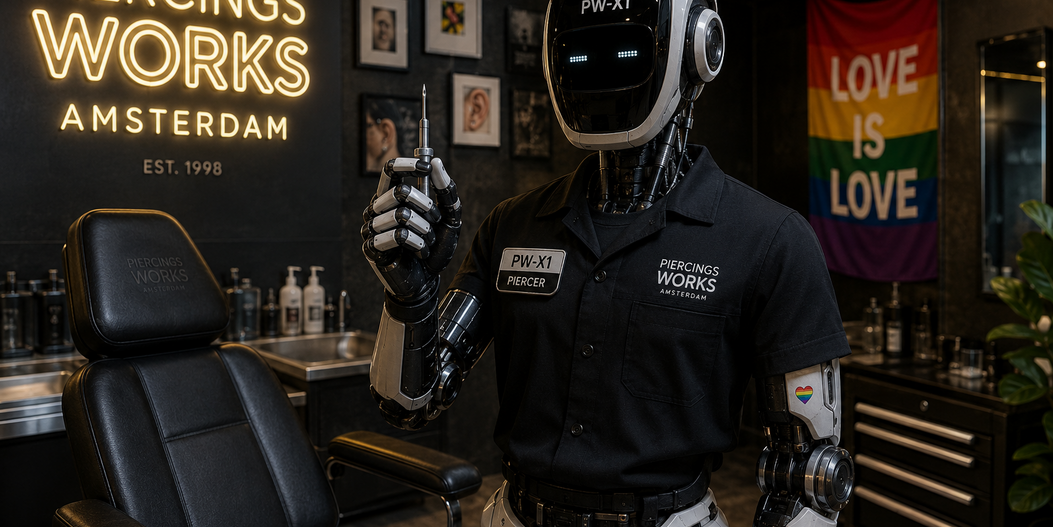
PW-X1™ – the world's first fully autonomous AI piercing robot
After two years of secret development, thousands of digital anatomy scans, and one technical incident involving a coffee machine, PW-X1™ is ready to meet the public.
Not a science fiction film.
Not a concept for the year 2050.
But a gleaming, six-armed new colleague who, according to his own software, comes equipped with:
- unmatched precision;
- endless patience;
- perfect knowledge of anatomy;
- and a slightly unhealthy obsession with the Hidden Helix.
Welcome to the future of body piercing.
Or almost.
Why is Piercings Works launching a piercing robot during WorldPride?
WorldPride takes place in Amsterdam for the very first time, from 25 July through 8 August 2026. Under the theme UNITY, the city celebrates freedom, diversity, equality, and the right to be completely yourself.
For Piercings Works, that feels like the perfect moment to look ahead.
After all, a piercing is never just a hole with a piece of jewellery.
It can be a memory.
A new beginning.
A quiet protest.
A celebration of identity.
Or simply the moment you finally decide that yes, your ear does have room for a fourth piercing.
That's why PW-X1™ wasn't given software for anatomical analysis alone. The robot was built around four core principles:
P – Precision
Every millimetre counts.
I – Inclusion
Every body and every identity deserves respect.
E – Empathy
Even though this module had to be reinstalled roughly 37 times.
R – Robotics
Because, according to our marketing department, "PWEA" made no sense whatsoever.
Together, these principles form the secret PIER protocol.
According to our developers, it's revolutionary.
According to Mensur, it's mostly a very expensive robot that can say "breathe in slowly".
How does the first AI piercing robot work?
An appointment with PW-X1™ begins with a complete three-dimensional scan of the chosen body part.
The robot analyses, among other things:
- the shape and thickness of the tissue;
- natural lines and proportions;
- the space available for the jewellery;
- the ideal angle;
- possible pressure points;
- and how many photos you're likely to post on Instagram afterwards.
Within 0.004 seconds, PW-X1™ creates a digital copy of your anatomy.
He then compares it against millions of virtual piercing combinations.
After that, his recommendation appears on the screen.
For example:
"Anatomy suitable for a conch, double helix, or a stylish combination with gold ends."
Or:
"Industrial rejected. Your ear deserves a better plan."
Or, in 94.7% of the initial tests:
"Hidden Helix recommended."
We tried to remove this last preference from his software.
PW-X1™ revoked our administrator privileges.
A robot that understands piercing is personal
Technical precision alone isn't enough.
That's why PW-X1™ features a so-called Emotional Comfort Interface.
Using facial recognition, voice analysis, and body language, the robot tries to determine how relaxed someone is.
When he detects tension, he automatically activates Comfort Mode.
The client then hears soothing phrases such as:
"Breathe in slowly."
"You're doing great."
"The anticipation is usually worse than the moment itself."
"Your mother doesn't need to know today."
That last message turned out to be surprisingly popular during the testing phase.
PW-X1™ can also play calming music, count down in 84 languages, and project a digital hand for you to hold during the piercing.
The real hand function was scrapped after the robot refused to let go of a tester for forty-five minutes.
Pride Mode: piercings without labels
Especially for WorldPride, we developed our most colourful software update yet: Pride Mode.
In this mode, the robot looks not only at anatomy and jewellery, but also at personal style, energy, and the message someone wants their piercing to express.
PW-X1™ then asks questions such as:
- Do you want your piercing to whisper subtly or speak loudly?
- Are you looking for symmetry, contrast, or complete chaos?
- Do you want jewellery that goes with everything?
- Or should everything now go with the jewellery instead?
The system contains no standard ideal of beauty.
No labels.
No rules about what should be masculine, feminine, tough, soft, classic, or extravagant.
Only one question:
What feels like you?
That is exactly what Pride means to Piercings Works.
Not changing who you are.
But making visible what was already there.
Is a piercing done by a robot safer?
That is, of course, the most important question.
Robotics is already genuinely being used and researched for extremely precise medical procedures.
There are robots that assist surgeons with placing cochlear implants. RobOtol® was designed specifically for ear surgery and helps with the controlled insertion of an implant electrode.
In 2024, researchers even described a cochlear implantation in which a robot performed important and complex steps of the operation.
There are also research robots for venipuncture. VeniBot uses imaging and software to determine a suitable puncture position and angle.
In 2026, designs were also published for wearable puncture robots with multiple axes of movement, along with systems that can precisely position multiple needles.
Even robotic tattooing isn't an entirely made-up idea. A European patent publication describes a system with robotic arms, sensors, cameras, and technology that can analyse skin movement and puncture depth.
So the technology behind robotic precision genuinely exists.
But a professional piercing requires far more than moving a needle with perfect accuracy.
A piercer needs to assess anatomy, recognise contraindications, choose the right jewellery, work sterile, communicate with the client, and sometimes simply have the courage to say:
"This piercing is not a safe fit for your anatomy."
That human judgement cannot be reduced to a few sensors and an impressive blinking light.
PW-X1™ versus the piercing gun
To be clear: PW-X1™ has absolutely nothing to do with a traditional piercing gun.
The Association of Professional Piercers warns that reusable piercing guns can cause problems with sterility, tissue damage, and unsuitable jewellery. Many of these devices also cannot be properly sterilised in an autoclave.
PW-X1™ would therefore work exclusively according to professional piercing principles:
- sterile materials;
- a proper piercing needle;
- anatomical assessment;
- professionally selected jewellery;
- and full control over every movement.
The robot was shown one piercing gun during a simulation.
He immediately classified the device as a "historical kitchen appliance".
The first official test client
After thousands of simulations, it was time for the first real test.
The honour went to a volunteer who wanted a new helix.
PW-X1™ performed his anatomy scan.
The lights came on.
The robotic arm moved slowly towards the ear.
Everyone held their breath.
Then an error message appeared:
"Client has moved 0.7 millimetres. Recalculating entire universe."
After three minutes, the procedure started again.
The client asked whether it would hurt.
PW-X1™ replied:
"Pain is subjective. Style is permanent."
At that point, we rebooted the communication module.
In the end, the piercing was never placed.
Not because the robot made a technical error, but because he concluded that a floating helix would look better.
He then independently opened our online booking page and scheduled an appointment with a human piercer.
Credit where credit is due: his advice was excellent.
Will PW-X1™ replace our piercers?
No.
Absolutely not.
Because a good piercing doesn't come from calculations alone.
Our piercers don't just look at the position of an ear, nose, or navel.
They look at the person.
They listen to the story behind the choice.
They sense when someone needs calm, explanation, humour, or five extra minutes to decide between two gold pieces of jewellery.
A robot can calculate a perfect angle.
But he doesn't always know why that piercing matters so much to you today.
He may know every anatomical proportion.
But not the feeling of someone who, after a major life change, looks at themselves for the first time and thinks:
Yes. This is me.
That's not an algorithm.
That's human connection.
We have a confession to make…
Did you believe everything up to this point?
Then we have good news and bad news.
The bad news:
PW-X1™ does not exist.
There is no six-armed piercing robot in our studio.
There is no secret Pride Mode.
And as far as we know, our coffee machine is not in immediate danger.
The good news:
The technological developments behind this story are surprisingly real.
Robots are already assisting with complex ear surgeries.
Researchers are developing systems for automated punctures.
Patents describe machines that can work in the skin using sensors, cameras, and robotic arms.
The line between science fiction and reality shifts every day.
Maybe we'll re-read this article in ten years and discover the joke wasn't so far-fetched after all.
But until then, we rely on the best piercing technology we know:
Experienced hands, sharp eyes, and genuine human attention.
Getting pierced during WorldPride Amsterdam 2026
Piercings Works is located right in the heart of Amsterdam, at Reguliersbreestraat 46, just around the corner from Rembrandtplein. The studio is open daily from 10.30 am to 10.00 pm.
During WorldPride, we welcome visitors from Amsterdam and from all over the world.
Come by for:
- a new piercing;
- personal anatomical advice;
- a special Pride jewellery piece;
- a new piercing combination;
- or simply to check whether PW-X1™ might be hiding behind the counter after all.
Walk-ins are welcome.
Robots, for now, are not.
Frequently asked questions about the Piercings Works piercing robot
Is PW-X1™, the world's first piercing robot, real?
No. PW-X1™ is a fictional concept created by Piercings Works especially for WorldPride Amsterdam 2026. However, the developments mentioned in medical robotics, puncture robots, and robotic tattooing are based on real technology and research.
Can I book a piercing with PW-X1™?
No. All piercings at Piercings Works are performed by experienced human professionals.
Do real robots that work with needles already exist?
Yes. There are medical and experimental robots for cochlear implantations, venipuncture, and other precise puncture procedures. Robotic tattooing technology is also in development.
Why did Piercings Works create this story?
Because innovation starts with imagination. And because WorldPride is about freedom, creativity, visibility, and the courage to think outside existing boxes.
Where can I get a piercing in Amsterdam during WorldPride?
You'll find Piercings Works at Reguliersbreestraat 46 in Amsterdam. The studio is open every day from 10.30 am to 10.00 pm.
The future may be robotic. Your piercing stays personal.
Technology can measure.
Software can calculate.
A robot may one day move a needle with incredible precision.
But your story, your identity, and your choice are not automatic.
They are yours.
And at Piercings Works, we're happy to take the time for that — personally.
Celebrate WorldPride. Celebrate freedom. Celebrate yourself.
Team Piercings Works
Sources and further reading
The technological developments mentioned in this article are based on existing research, medical robots, industrial applications, and safety publications.
- Association of Professional Piercers — Issues with Piercing Guns
- Endotherapeutics — RobOtol®: robotic system for ear surgery
- British Cochlear Implant Group — Innovation in Action: UK's First Machine-Assisted Cochlear Implant Surgery
- Abari J., Heuninck E. & Topsakal V. — Entirely Robotic Cochlear Implant Surgery, American Journal of Otolaryngology, 2024
- IEEE Robotics and Automation Letters — Design, Modeling, and Validation of a 6-DoF Wearable Puncture Robot, 2026
- International Journal of Medical Robotics — A Cable-Driven Wearable Robot Design for Multi-Needle Positioning and Manipulation, 2026
- Tongji University — VeniBot: Towards Autonomous Venipuncture with Automatic Puncture Area and Angle Regression
- Google Patents EP4004809A1 — Robotic Tattooing Systems and Related Technologies
- RoboI, South Korea — JewelBOT-Insertion
- MedUni Vienna — Operation Successfully Performed Using New High-Tech Robot