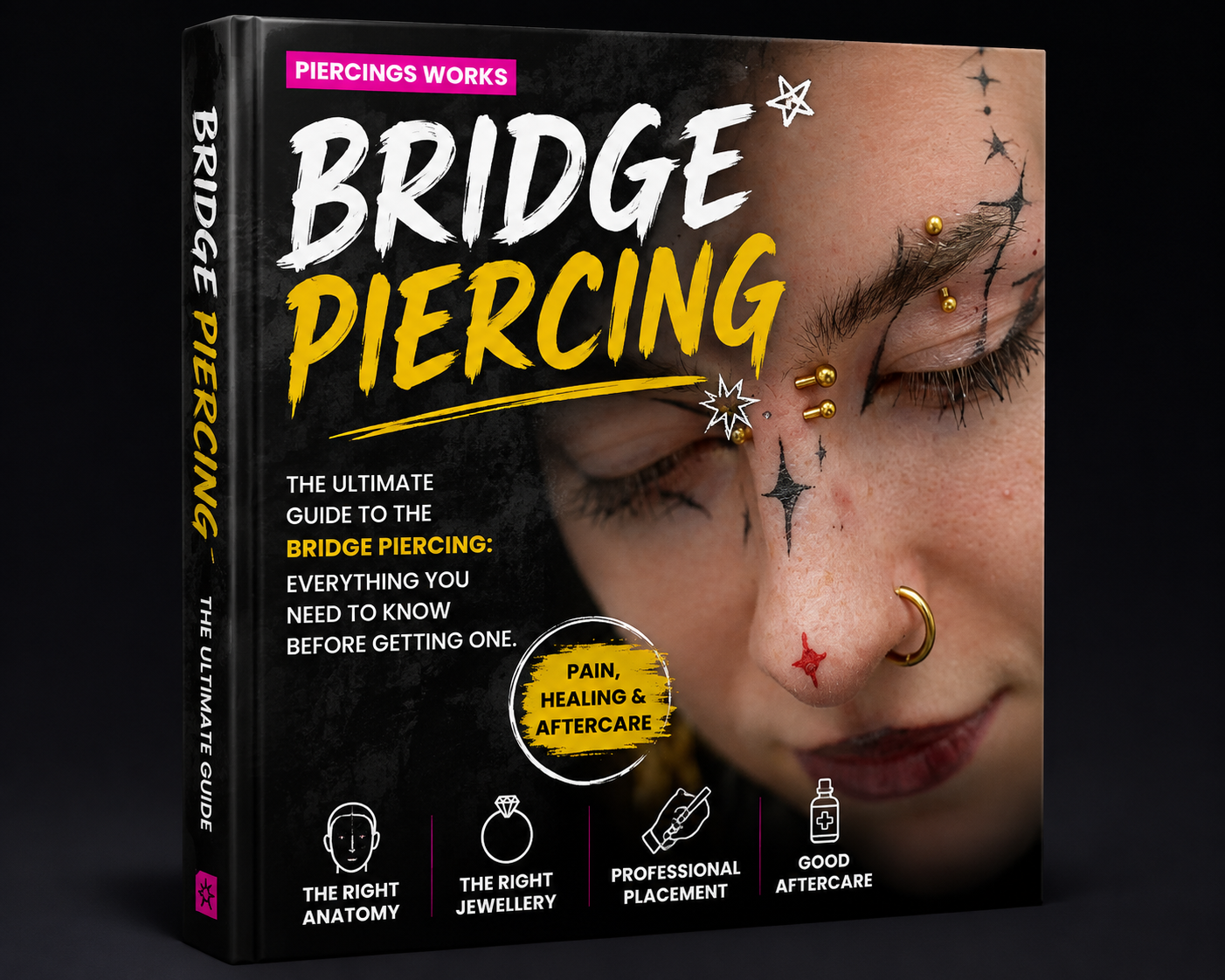
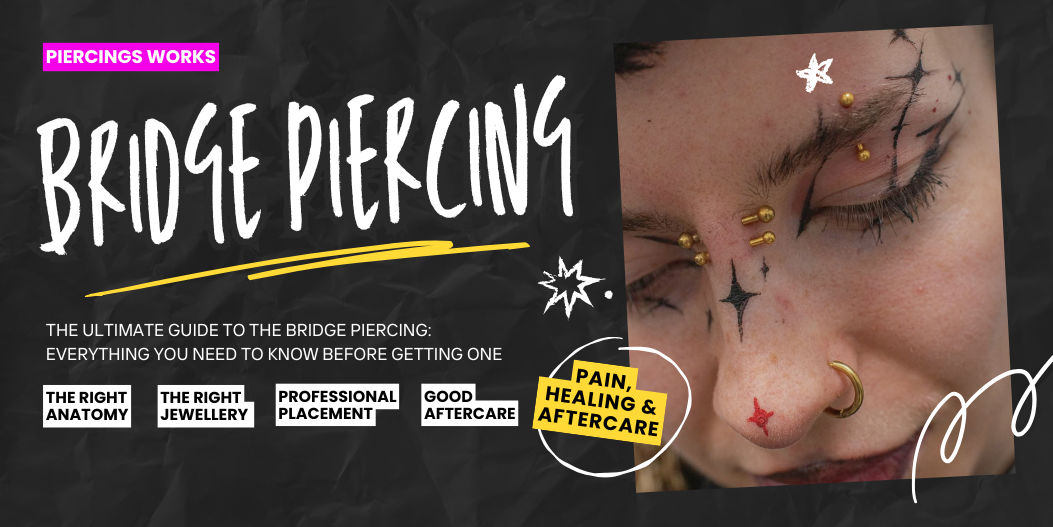

Some piercings stand out. And then there’s the bridge piercing.
Sitting right between your eyes, on the bridge of your nose, this small piece of jewellery changes the entire balance of your face. Subtle it is not — and that’s exactly why people choose it.
In this guide, you’ll find everything you need to know: how the piercing works, how long healing takes, which risks to consider, and why anatomy matters more here than with almost any other piercing.
What is a bridge piercing?
The bridge piercing — also known as the Erl piercing, after Earl van Aken, its first known wearer — is a horizontal piercing through the loose skin tissue on the bridge of your nose, right between the eyes.
Important to know: the piercing does not go through bone or cartilage. Skin only. That officially makes the bridge a surface piercing, with all the benefits and points of attention that come with it.
Not every nose bridge is suitable — and that’s okay
Here’s the honest story you should expect from a professional studio: not everyone can wear a bridge piercing.
A safe and beautiful bridge requires enough loose skin tissue on the bridge of the nose. If the skin is too tight, the risk of rejection or migration is too high.
That’s why every bridge at Piercings Works starts with an anatomical check. Our piercers assess:
- the amount and looseness of the tissue
- the symmetry of your face and the ideal placement
- whether glasses or other factors could affect healing
- which jewellery suits your anatomy
If the bridge doesn’t fit your anatomy, we’ll tell you honestly — and help you find an alternative that does sit safely.
Does a bridge piercing hurt?
Surprisingly little. Because the needle only passes through skin tissue and doesn’t touch cartilage, most people experience the bridge as milder than a septum or helix, for example.
What you will notice right away: you can see the jewellery. Your eyes need a little time to get used to that new dot in your field of vision. That passes within a few days.
Healing: 8 to 12 weeks, with discipline
A bridge heals in 8 to 12 weeks on average, though full stabilisation can take longer. As a surface piercing, it demands extra care:
- Don’t touch it. Every touch is a risk.
- Rinse 1-2 times a day with sterile saline solution.
- No make-up, creams, or sunscreen on the piercing.
- Be careful with glasses and sunglasses — make sure the frame doesn’t touch the jewellery.
- Don’t sleep on your face.
- Helmet, ski goggles, or diving mask? Check with your piercer first.
Full aftercare instructions can be found on our aftercare page.
The biggest risk: migration and rejection
Any surface piercing can slowly be pushed out by the body. You reduce that risk through:
- The right anatomy (hence the check beforehand)
- The right jewellery — implant-grade titanium in the correct size
- Professional placement at the correct depth
- Good aftercare and patience
If you notice the jewellery sitting flatter under the skin, or the skin between the entry points getting thinner: come see us. Removing it in time prevents a lasting scar.
Which jewellery fits a bridge?
The classic choice is a straight or slightly curved barbell in implant-grade titanium, usually 1.6 mm thick. Once healed, you can play with:
- balls in different colours and sizes
- premium zirconia ends
- 18K gold accents
Our team is happy to help you choose the right size — with a bridge, a barbell that’s too long or too short isn’t a detail, it’s a risk factor.
Getting a bridge piercing in Amsterdam
At Piercings Works, we work exclusively with:
- Implant-grade titanium
- Sterile single-use materials
- Professional piercers with years of experience
- An honest anatomical check beforehand
Piercings Works Reguliersbreestraat 46, Amsterdam — just around the corner from Rembrandtplein
Open daily from 10:30 am to 10:00 pm Walk-ins welcome, or book an appointment
Current prices are listed in our studio price list.
Frequently asked questions about the bridge piercing
Does a bridge piercing go through bone?
No. The bridge only passes through the loose skin tissue on the bridge of the nose — not through bone or cartilage.
Can I get a bridge piercing if I wear glasses?
Often yes, but it depends on your frame and anatomy. Bring your glasses to the studio — we’ll check together.
How long does healing take?
On average 8 to 12 weeks with good aftercare. Full stabilisation can take several months.
What if my anatomy isn’t suitable?
Then we’ll tell you honestly. We don’t place piercings that can’t sit safely — instead, we’ll help you find an alternative.
Will I get a scar if I remove the bridge?
With timely, professional removal, any scar usually stays minimal. If rejection goes on too long, the scar can be bigger — so come by early if in doubt.
Ready to stand out?
A bridge piercing is not a piercing you hide. It’s a statement, right between your eyes.
Come by for an honest anatomical check — and find out whether the bridge is right for you.
Piercings Works Amsterdam — since 1998.