
We've put the most popular pairs side by side: where they sit, what jewellery goes in, how spicy they feel and how practical they are day to day.
First things first: your ear has a say
Not every ear suits every piercing. The rook, daith, snug and industrial especially depend heavily on your anatomy. That's why your piercer always looks at the shape of your ear first. Sometimes the answer to "daith or rook?" is simply: that one suits you better.
Daith vs rook
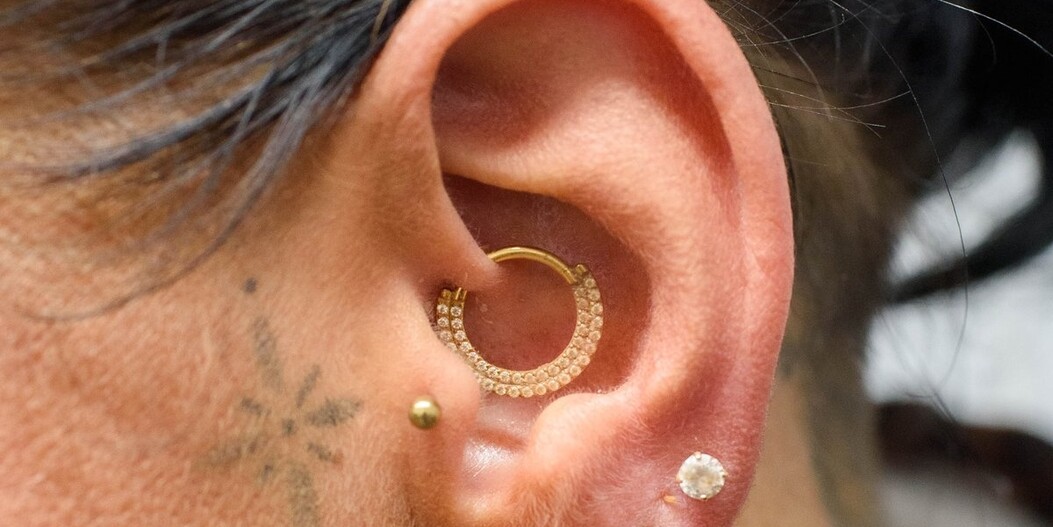
Where are they? The daith sits in the innermost cartilage fold, just above the entrance to your ear canal. The rook sits in the antihelix: the firm cartilage fold above your tragus, deep in your ear.
Jewellery: a daith is often finished with a ring. It looks great and suits the shape of that spot. A rook is pierced as standard at 1.2 mm, usually with a curved barbell or a ring.
Pain: both go through firm cartilage. In our pain chart, daith and rook are in the 'intense' category: short, but spicy.
Everyday life: in-ear earbuds can press on a daith. A rook is less practical if your ear often gets pressure, for example from headphones or sleeping on that side.
Go for: a daith if you love a ring that curls beautifully into your ear. A rook if you want a subtle, tucked-away look deep in your ear.
Flat vs helix
Where are they? The helix sits in the outer rim of your upper ear. You can also go for a forward helix (at the front, towards your face) or a double or triple helix. The flat sits on the flat area of cartilage inside that rim.
Jewellery: a helix often wears a ring or a labret. During healing your piercer goes for a labret; after that, it's your style. A flat is a spot for a pretty top on a labret with a flat disc on the back. Ideal if you love studs.
Pain: both are cartilage, so usually a bit spicier than a lobe. The helix sits in the 'medium' group of our pain chart.
Everyday life: a helix can get pinched by the cushions of over-ear headphones. Wear glasses? The arm runs right along your ear, so check the spot with your piercer.
Go for: a helix if you like your piercing to stand out or want a ring later. A flat if you're after a delicate top or a cluster of studs.
Helix vs conch
Where are they? The conch sits in the middle of your ear shell, in the thickest cartilage of your ear. An inner conch sits deep in the middle of your ear, an outer conch on the flat outer part.
Jewellery: an inner conch is ideal for a ring once it has healed. An outer conch is perfect for studs or labrets. A helix can do both, as above.
Everyday life: the conch sits on a spot that takes daily pressure. The arms of your glasses can press on the jewellery, and over-ear and on-ear headphones can get in the way. In-ear earbuds, on the other hand, often work fine with a helix or conch.
Go for: a conch if you want a statement right in the middle of your ear. A helix if you want a classic start and plan to add more later.
Healing: all cartilage, all patience
All six are cartilage piercings. Cartilage heals more slowly than a lobe: think months, not weeks. How long it takes for you depends on the spot and on you. Your piercer will tell you what to expect. Preferably don't sleep on the side of your new piercing, and only change jewellery once your piercing is ready.
Aftercare is the same for all six: wash with lukewarm water, pat dry gently and touch your piercing as little as possible. Care for your piercing daily with the Aphraheals Piercing Aftercare Spray: it keeps your new or healing piercing clean. Beyond that, you don't need ointments or other products. Never take your piercing out yourself. Read everything in our aftercare instructions.
Several at once?
Want more than one? For a big ear project, we usually start with the placements that are anatomically the most critical or take the longest to heal, such as the conch, daith, rook and industrial. After that, the helix, forward helix and flat can be added. More tips in Would you like to get several ear piercings at the same time?
Jewellery and material
For a fresh piercing titanium is best, but gold is possible too: we often use a titanium bar with a gold attachment. Gold is fine for a new piercing too, but the first bar is longer and is later replaced with a shorter one. That's why we usually use a titanium bar with a gold attachment. Our gold is solid 14K and 18K gold (most in 18K). Curious about thicknesses and lengths? Check All about sizes.
Come in for advice
Between 12 and 16? Then a parent or guardian comes along and signs the consent form, and you both bring ID. From 16 you can come on your own, with your own ID. More on our minimum age page. For costs, check our studio price list.
From Ira, with love
Ira Lutvica is co-owner of Piercings Works, which she runs together with her husband Mensur Lutvica: since 1998, and 22 years at the same spot on Reguliersbreestraat 46. Ira writes the books herself and runs the piercing course (in Dutch), where she has trained 100+ piercers. Want to know more about this topic? Read her e-book (in Dutch) Daith Piercing. Also read Piercings Works in the media.
Piercings Works has been piercing in Amsterdam since 1998, and has been on the Reguliersbreestraat since 2004. We have more than 2,000 reviews and our team speaks six languages: Dutch, English, Spanish, Italian, Croatian and Indonesian. Still torn? Drop by and we'll look at your ear together.