
It's a question we hear all the time in the studio: "Should I go for a hoop or a stud?" Helix, nose or nipple, the choice feels like a big one. A hoop is playful with a little edge, a stud is clean and subtle. Good news: you don't have to choose forever. It does help to know what works best at which moment. Here's the lowdown.
First, the terms
- Stud: a straight bar with a ball, gem or other top on the front. For ear and nose piercings this is often a labret: a bar with a flat disc on the back, so it sits nice and flat against your skin.
- Hoop or ring: round jewellery, such as a clicker, a seamless ring or a segment ring.
- Barbell: a straight or curved bar with a ball on each end, like in an industrial, tongue or nipple piercing.
Why a fresh piercing usually starts with a bar
A new piercing mostly wants one thing: peace and quiet. A straight bar or labret moves less than a ring. A ring turns more easily, catches on your hair, your jumper or your headphones, and shifts when you sleep on it. That's why we usually choose a bar for a fresh piercing. Can you start with a ring? Sometimes, yes. But a bar or straight post generally heals better because it moves less. We look at your anatomy and your style together, then advise what works best.
The first bar is often slightly longer to leave room for swelling. Once your piercing has calmed down, a shorter bar that fits more snugly can go in. That's called downsizing.
Per piercing: what's common?
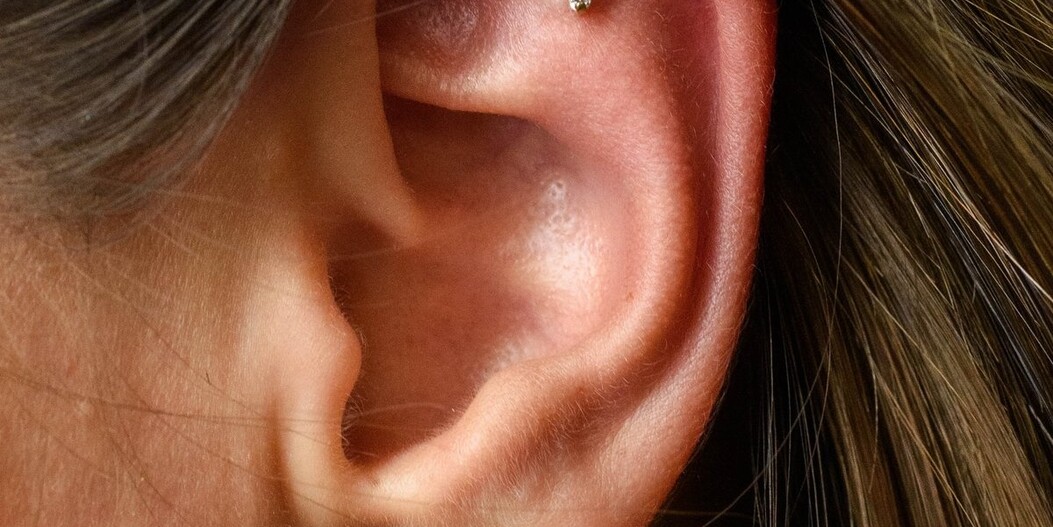
- Helix: the most common jewellery is a ring or a labret. During healing your piercer goes for a labret; after that, it's your style.
- Conch: an inner conch (deep in the middle of your ear) is ideal for a ring once it has healed. An outer conch (on the flat outer part) is perfect for studs or labrets.
- Daith: here a ring is actually often the logical choice. Your piercer takes extra care to read the shape of your ear.
- Nose (nostril): often a nose stud or labret; a ring can come later.
- Nipple: usually a straight bar (barbell). A ring often comes later.
Every ear and every body is different, so treat this as a guideline. Your piercer checks what suits your shape.
From stud to hoop: when can you switch?
Once your piercing has fully healed, you can switch to a ring. How long that takes depends on the spot and on you. Cartilage usually needs months; a lobe is often quicker. Never take your jewellery out yourself while it's healing. Not sure if you're ready? Have it checked. Our post on opening and changing your piercing jewellery explains how different closures work.
Your first change is best done by us. Especially with gold, which is softer than titanium, that's the smart move. Our gold pieces have a titanium internal thread, so the closure stays secure.
The right size: thickness, length and diameter
A ring or bar has to fit. For most ear piercings 1.2 mm is the standard thickness, for a nose it's often 1.0 or 1.2 mm, and for nipple, navel and tongue 1.6 mm. With a ring, the diameter matters too: too tight presses, too loose catches. Our page All about sizes shows how to measure. Not sure? Drop by and we'll measure it together.
Titanium or gold?
For a fresh piercing titanium is best, but gold is possible too: we often use a titanium bar with a gold attachment. Gold is fine for a new piercing too, but the first bar is longer and is later replaced with a shorter one. That's why we usually use a titanium bar with a gold attachment. Our gold is solid 14K and 18K gold (most in 18K). Read more about materials in our FAQ on jewellery and materials.
Aftercare in a nutshell
Hoop or stud, the care is the same: wash your piercing with lukewarm water and pat it dry gently. Touch it as little as possible and don't play with it. Care for your piercing daily with the Aphraheals Piercing Aftercare Spray: it keeps your new or healing piercing clean. Beyond that, you don't need ointments or other products. Everything is in our aftercare instructions.
Ready to choose?
Between 12 and 16? Then a parent or guardian comes along and signs the consent form, and you both bring ID. From 16 you can come on your own, with your own ID. Which piercing is possible from which age is explained on our minimum age page. For costs, check our studio price list.
From Ira, with love
Ira Lutvica is co-owner of Piercings Works, which she runs together with her husband Mensur Lutvica: since 1998, and 22 years at the same spot on Reguliersbreestraat 46. Ira writes the books herself and runs the piercing course (in Dutch), where she has trained 100+ piercers. Want to know more about this topic? Read her e-book (in Dutch) Sieraad laten verwisselen?. Also read Piercings Works in the media.
Piercings Works has been piercing in Amsterdam since 1998, and has been on the Reguliersbreestraat since 2004. We have more than 2,000 reviews and our team speaks six languages: Dutch, English, Spanish, Italian, Croatian and Indonesian. Hoop, stud or both? We're happy to help you decide.