
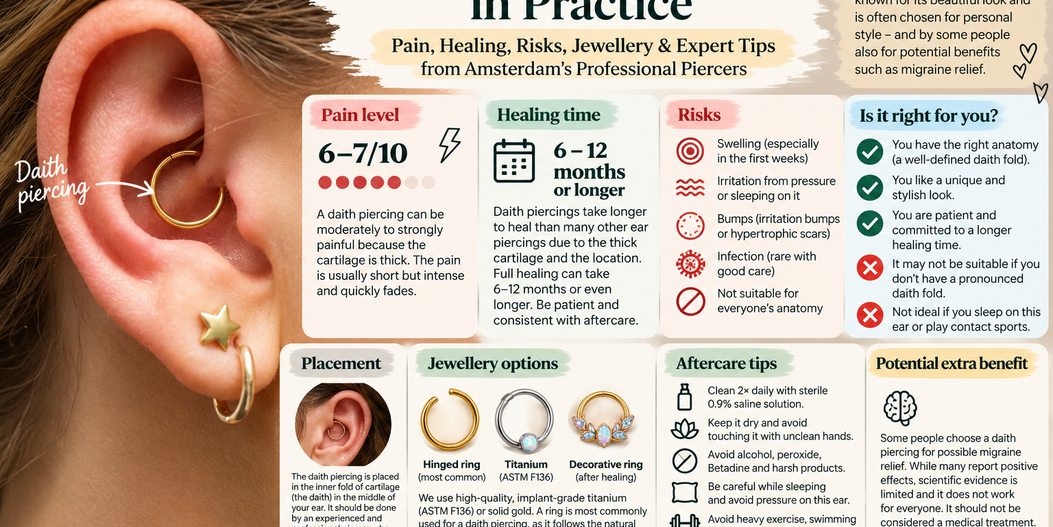

Many people feel unsure about the procedure: "Is my ear even suitable?" or "Why does a daith heal faster for one person than for another?". The key to a successful result lies not only in aesthetics, but in a thorough understanding of anatomical precision and technical skill. In this article we share the expertise of Senior Body Piercing Specialist Ira Lutvica to reveal the 'tricks of the trade' for a perfect daith experience.
The anatomical 'sweet spot': more than just a hole
A daith piercing is not a standard procedure; it requires the ability to read the unique landscape of the ear. The piercing is placed on the crux of the helix, the point where the helix turns into the forward helix and connects to the conch.
As a specialist, I first look for the ideal entry point by examining the cartilage ridge with a 'needle blank' or the back of a needle. The aim is to find that specific 'squishy' (soft) spot — the sweet spot — which often lies deep in a kind of 'little ravine' between the tragus and the anti-tragus. The needle has to fit exactly into this ravine to guarantee the right angle.
"...I have a lot of success piercing at the anatomical crux of the helix – that's where I believe a daith piercing belongs."
Why the ring is king (and the danger of the 'sinking' barbell)
Although some people choose a curved barbell, there's a strong technical preference for ring-shaped jewellery in a daith. Using the wrong jewellery can lead to serious complications.
- Prevent 'sinking': With a bar that's too small, gravity can cause the top ball to 'sink' into the tissue and eventually become embedded.
- The right parameters: For healthy healing, the jewellery has to meet specific requirements:
- Diameter: Large enough to accommodate natural swelling without pressing too tightly on the tissue.
- Thickness (gauge): Usually 1.2mm or 1.6mm for maximum stability of the channel.
- Post length: Essential to prevent embedding at the top.
The invisible preparation: toothpicks and hygiene
Precision starts long before the needle touches the skin. One specialist method is to use a sterilised toothpick and gentian violet. This is used to make extremely fine dots for the entry and exit points, which is far more accurate than a standard marker pen.
Hygiene leads the way here. Because the ear has lots of folds where oil and bacteria collect (such as behind the tragus or under the rook area), we first clean the skin thoroughly with alcohol or a PCM skin cleanser. Only then do we make the final marking, so it doesn't fade during the sterile preparation. During the procedure we work with a sterile drape and any other piercings in the area are covered with extra gauze to keep the work area sterile.
'Burying' the piercing: aesthetics vs. healing
'Burying' a daith — placing the piercing extra deep — is a common aesthetic wish. As a specialist, however, I have to keep the balance between appearance and ease of healing. A piercing placed too deep is almost impossible for the client to keep clean, while a placement that's too shallow increases the risk of the piercing growing out (migration) because of a lack of healthy blood supply.
To achieve this precision, we use a glass receiving tube. The advantage of glass is that we can see both the entry and exit point crystal clear and aim exactly at our target. The tube also provides the necessary counter-pressure and stability with uneven anatomy or a prominent cartilage ridge.
The needle itself is prepared with a bend of about 30 degrees, positioned at around 2/3 of its length. This curve is crucial for a smooth jewellery transfer after piercing.
The 'seam-style' ring: precision in the closure
Many daith piercings are finished with a seam-style ring. With this type of jewellery, the finish of the closure is vital. When the ring is closed, the edges of the seam have to line up perfectly.
Pro tip from the specialist: When opening and closing the ring, we always bend it in the same direction. Bending the ring in opposite directions distorts its circular shape. Poor alignment can pinch the skin or cause irritation when the seam moves through the channel. Note: the angle a photo is taken from often determines how the piercing looks; from the front, a correctly placed daith always looks the most natural and symmetrical.
The danger of 'build-up': why you shouldn't pick
A healthy daith stands or falls with aftercare. During healing, the body produces wound fluid that dries on the jewellery; we call this stubborn dried-on build-up.
It's essential to rinse this discharge away thoroughly. If the ring moves — on purpose or by accident — these hard, sharp crusts can be pulled into the fresh piercing channel. This causes micro-wounds and significantly increases the risk of infection. Our advice: Rinse away build-up with water or a saline solution, but never pick aggressively at the crusts with your fingers.
Conclusion: your unique anatomy as the guide
A successful daith piercing is the result of respect for human anatomy, the choice of high-quality ring-shaped jewellery and the technical precision of the specialist. By focusing on the sweet spot in the crux of the helix and using the right instruments, such as the glass receiving tube and correctly bent needles (1.2mm or 1.6mm), we lay the foundation for a beautiful, healthy result.
In the end, a happy piercing starts with understanding your own body and good communication with your piercer.
Getting a daith piercing in Amsterdam?
If you want certainty about placement, hygiene and results:
Piercings Works – more than 2,000 reviews, experience since 1998 and the authority on piercing technique in Amsterdam.
Book an appointment: https://www.piercingzetten.com/