
“How does that actually work?”
It's a question we regularly get in the studio:
“How come I can often get a piercing at sixteen, but I'm not allowed to buy cigarettes yet?”
At first glance that might seem strange.
Both have something to do with your body. Both involve a choice. And both have an age limit.
Yet there's a clear reason behind this difference.
A piercing and a cigarette simply aren't the same kind of choice.
A piercing is body adornment; tobacco is a harmful and addictive product
A piercing is usually seen as a form of body adornment and personal expression.
You choose something for your appearance. For your style. For your identity. For how you want to carry your body.
A cigarette is something else.
Tobacco and nicotine are products known to be harmful to health and potentially addictive. In the Netherlands it's against the law to sell tobacco products to anyone under 18. The NVWA (the Dutch Food and Consumer Product Safety Authority) specifically points out that young people become addicted more quickly and that tobacco and nicotine are extra harmful to their bodies and brains.
That difference matters.
A piercing requires responsibility.
A cigarette carries a risk of addiction and damage to your health.
Those are two completely different categories.
A piercing doesn't cause physical addiction
When someone gets a piercing, they're making a choice about their own body and appearance.
Of course that choice needs careful thought. A piercing needs aftercare. Healing takes time. The jewellery has to be suitable. The placement has to be right. And you need to understand what you should and shouldn't do during the healing process.
But a piercing doesn't cause physical dependence.
With tobacco it's different. Nicotine can be addictive, and that's exactly why governments try to protect young people from starting to smoke for as long as possible.
That's why the limit for cigarettes and other tobacco products is stricter: you can only buy them from 18.
What do Dutch rules say about piercings?
In the Netherlands, tattoos and piercings broadly have an age limit of 16. Young people aged 12 to 16 may only get a piercing under certain conditions: with the consent and presence of a parent or guardian. Piercings are not allowed for children under 12, except for earlobe piercings. (At Piercings Works we only tattoo clients aged 18 and over – that's our own studio rule.)
There are also extra restrictions for under-16s. Genital piercings are not allowed, for example, and nipple piercings are prohibited for girls under 16.
So from 16 you get more freedom to make your own choices about body adornment.
But note: a legal age limit doesn't automatically mean every piercing is a sensible choice at every age.
Age isn't the only thing we look at
At Piercings Works we never look only at your age.
Age is one part of it.
Not the whole story.
We also look at:
anatomy,
health,
healing,
choice of jewellery,
placement,
aftercare,
and whether someone understands what a piercing needs.
Because a piercing isn't a sticker you put on your body. It's a small wound that has to heal with a piece of jewellery in it.
That takes care. Attention. Hygiene. And honesty.
Sometimes that means: yes, this is absolutely fine.
Sometimes it means: better to wait a little longer.
Sometimes it means: this piercing doesn't suit your anatomy.
And sometimes it means: we choose a safer alternative.
That's not being strict.
That's working professionally.
“Allowed” doesn't automatically mean “good idea”
This may be the most important point.
Just because something is legally allowed doesn't always mean it's the best choice at that moment.
A piercing can be technically allowed, but still not sensible because of your anatomy, sport, holiday plans, work, skin condition, health or how well you can follow the aftercare.
For example: if you're about to spend three weeks swimming, sunbathing and travelling, a fresh piercing might not be the smartest souvenir to get before you leave.
Small body, big logistics. Your piercing doesn't want a chaotic diary.
That's why we always think it through with you. Not to hold you back, but to make sure your choice still feels right in the long run.
Why do rules differ between countries and studios?
Age limits are legal choices. That's why the rules can differ from country to country and sometimes from region to region.
On top of that, professional studios may set their own conditions, as long as they at least stay within the law.
So a studio can be stricter than the law. For example, by only doing certain piercings from 18, asking for extra identification or not piercing at all if in doubt.
That's not strange. That's responsibility.
A good studio doesn't only think about what's possible today, but also about what will heal safely tomorrow.
In the end it's all about responsibility
The discussion isn't really just about age.
It's about responsibility.
Can you follow the aftercare properly?
Do you understand what healing involves?
Do you know you shouldn't twist or pick at your piercing?
Do you see why swimming, make-up, skincare or pressure from clothing can be a problem?
Can you make a well-considered choice?
Those are often more important questions than just the number on your ID.
Because getting a piercing is one moment.
But letting a piercing heal properly is a process.
In short
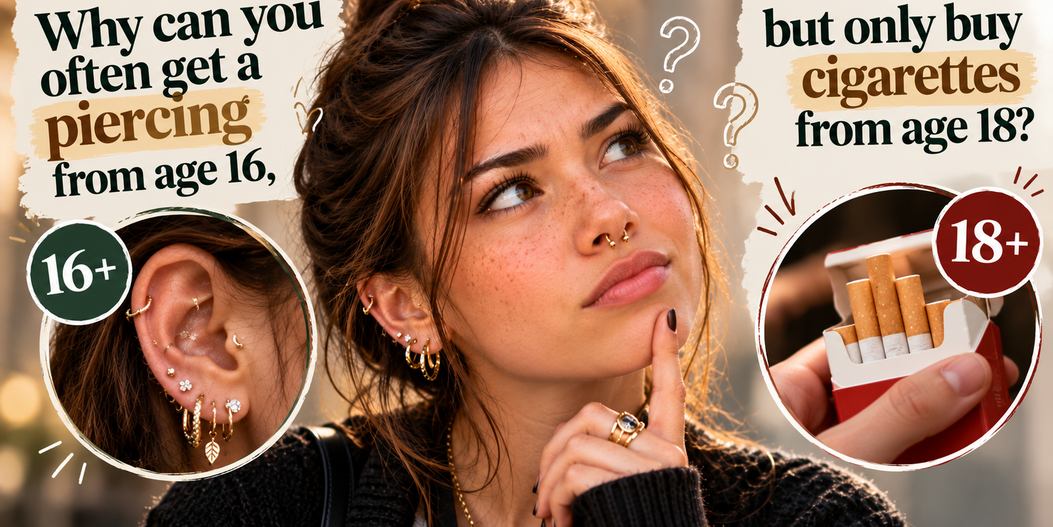
Why can you often get a piercing from 16, while cigarettes can only be bought from 18?
Because a piercing is usually seen as body adornment and personal expression, while tobacco and nicotine are harmful and addictive products. In the Netherlands, selling tobacco products to young people under 18 is prohibited. Different rules apply to piercings, giving young people more freedom to choose for themselves from 16.
But at a professional piercing studio it doesn't stop at the question: “Is it allowed?”
The better question is:
“Is it sensible, safe and right for your body?”
And that's exactly what we look at at Piercings Works.
Getting a piercing at Piercings Works
Want to get a piercing in Amsterdam, with honest advice about age, anatomy, choice of jewellery and healing?
At Piercings Works we take the time to look at it with you. We give advice that suits your body, your age and your situation.
Book your appointment via:
https://www.piercingzetten.com/
Frequently asked questions
Can I get a piercing at 16 without my parents?
In the Netherlands, 16 is an important age limit for piercings. Young people aged 12 to 16 need the consent and presence of a parent or guardian (at Piercings Works this means a signed consent form, and you both bring ID). From 16, that parental presence is usually no longer required under the general Dutch rules – at Piercings Works you can come on your own from 16. Always check the studio's conditions beforehand, though, as studios may have their own rules.
Can you get a piercing under 16?
Between 12 and 16 a piercing is only allowed under certain conditions, with the consent and presence of a parent or guardian. Some piercings are not allowed under 16, such as genital piercings and nipple piercings for girls. Under 12, piercings are not allowed, except for earlobe piercings.
Why can you only buy cigarettes from 18?
Because tobacco and nicotine are harmful and can be addictive. In the Netherlands, selling tobacco products to anyone under 18 is prohibited by law.
Does Piercings Works do every piercing from 16?
Not automatically. We always look at age, anatomy, health, aftercare, placement and whether the piercing is sensible for your situation. Sometimes waiting or choosing an alternative is the best option.
Why does a piercing studio ask for ID?
Because age checks are part of working professionally and responsibly. A studio has to be able to check whether someone meets the age requirements for the piercing they want.