
What is a rook piercing?
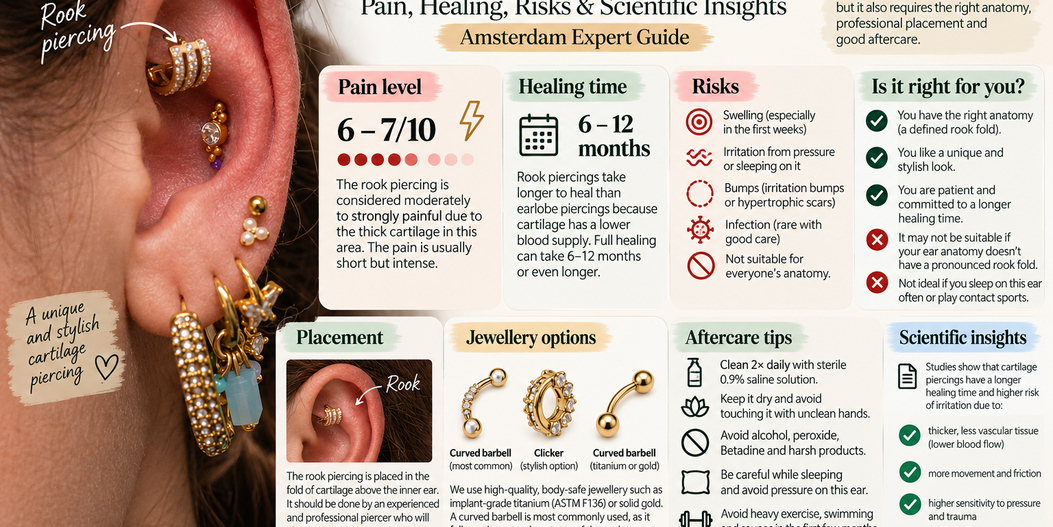
The rook piercing is placed in the antihelix – the firm fold of cartilage above the tragus, deep inside the ear.
It's one of the more technically difficult ear piercings because:
- it goes through thick, compact cartilage
- space is limited
- placement has to be extremely precise
As standard it's done with a 16G (1.2 mm) needle and usually a curved barbell or ring.
Why do people choose a rook piercing?
The rook piercing isn't a “first piercing”. It's a choice for:
- more complex ear styling
- depth and layering in the ear
- a more exclusive look
It literally sits “deeper” in the ear — and that gives it visual character.
Does a rook piercing hurt?
On average the pain is described as:
6–7 out of 10
That's because:
- you go through two layers of cartilage
- the area is compact and sensitive
Professional sources confirm that cartilage piercings feel more intense than soft-tissue piercings.
https://www.medicinenet.com/how_bad_do_rook_piercings_hurt/article.htm
Even so, the experience is usually short — seconds rather than minutes.
Healing: a long but predictable process
The rook piercing has a relatively long healing time:
- 6 to 18 months
Why so long?
Cartilage has:
- less blood flow
- slower cell renewal
- limited flexibility
This makes it more sensitive to disruption.
Professional guidelines stress that cartilage piercings take significantly longer to heal than lobes.
https://www.healthline.com/health/how-much-does-it-hurt-to-get-the-rook-of-your-ear-pierced
Infection risk: what the science says
Medical literature clearly shows that cartilage piercings carry a higher risk of infection.
Key findings:
- infections are the most common complication of piercings
https://pubmed.ncbi.nlm.nih.gov/22175301/ - Pseudomonas aeruginosa is a common bacterium in cartilage infections
https://wwwnc.cdc.gov/eid/article/29/10/23-0560_article - contaminated aftercare products can even cause outbreaks
(CDC 2023)
The UK Health Security Agency confirms:
- cartilage piercings carry a higher risk of perichondritis (inflammation of the cartilage)
https://www.gov.uk/government/publications/pseudomonas-aeruginosa-perichondritis-associated-with-ear-piercings
Serious complications: what can happen
In rare cases, infections can escalate.
Documented cases show:
- necrotising cartilage infections
https://pmc.ncbi.nlm.nih.gov/articles/PMC3080532/ - severe inflammation after unhygienic procedures
https://pmc.ncbi.nlm.nih.gov/articles/PMC1781501/
These situations are almost always caused by:
- poor hygiene
- the wrong aftercare
- unprofessional work
Keloids and scarring
Scarring is an important factor with cartilage piercings.
Studies show:
- an increased chance of hypertrophic scars and keloids
- especially with a genetic predisposition
https://www.mdedge.com/content/complications-body-piercings-systematic-review
This makes correct placement and aftercare even more important.
Rook piercing and migraine: fact or myth?
The rook piercing is sometimes compared with the daith piercing, which some people associate with migraine relief.
Scientific insights:
- some studies suggest neurological modulation via the vagus nerve
https://pmc.ncbi.nlm.nih.gov/articles/PMC5711775/ - other studies show no convincing evidence
https://pmc.ncbi.nlm.nih.gov/articles/PMC7075511/ - there are even cases where symptoms got worse
https://pmc.ncbi.nlm.nih.gov/articles/PMC10849747/
Conclusion:
There is no proven medical benefit of a daith or rook piercing for migraine. It remains speculative and individual.
A crucial difference: needle vs. piercing gun
Medical guidelines are extremely clear on this:
Piercing guns must not be used on cartilage.
Why?
- they cause more tissue damage
- they increase the risk of infection
- they give less control
https://www.publichealthontario.ca/-/media/Documents/I/24/ipac-risks-piercing-guns-devices-faq.pdf
A rook piercing should always be done with a sterile needle.
Choice of material: essential for healing
Best choice:
- implant-grade titanium
Why?
- biocompatible
- less irritation
- better healing
Poor materials increase the risk of:
- infection
- allergy
- inflammation
Aftercare: what really works
The medical consensus is simple:
- clean with clean water
- keep it dry
- don't twist or move it
- no harsh products
Over-cleaning is one of the biggest causes of irritation.
Common mistakes
Most problems are caused by behaviour:
- sleeping on the piercing
- changing the jewellery too early
- touching it with dirty hands
- underestimating the healing time
With cartilage, patience isn't optional — it's essential.
Is a rook piercing right for you?
Suitable if:
- you already have experience with piercings
- you have the patience for a long healing time
- you choose quality
Less suitable if:
- you expect quick results
- you don't want to do much aftercare
- there's often pressure on your ears (headphones, sleeping)
Getting a rook piercing in Amsterdam
With complex cartilage piercings, experience makes the difference.
Piercings Works – more than 2,000 reviews, experience since 1998, our own Piercing Academy and a VIP programme. Located in the centre of Amsterdam and open 7 days a week.
Book an appointment:
https://www.piercingzetten.com/
Contact:
[email protected]
Summary
The rook piercing is a complex cartilage piercing with a long healing time and a higher risk of infection.
Scientific insights show:
- infection is the biggest risk (especially Pseudomonas)
- healing takes 6–18 months
- cartilage is prone to complications
- correct technique and aftercare are essential
Conclusion
The rook piercing is not a simple piercing.
It's a combination of:
- anatomy
- technique
- discipline
When these are right, you get a strong, stable piercing.
When they're missing, complications follow.